
Emerging Modular Finance: The Underrated Structural Implication of Decentralized Layer 2 and Tokenized Reserves
This paper explores an overlooked inflection: the rapid ascendancy of modular blockchain architectures combined with tokenized treasury reserves as a latent structural disruptor in decentralized finance (DeFi) and broader capital markets. This signal may recalibrate capital flows, regulatory paradigms, and industrial structures over the coming decade.
Layer 2 solutions are on track to eclipse Ethereum’s Layer 1 in total value locked (TVL) imminently, while tokenized assets backed by sovereign and treasury reserves gain traction as programmable money. This modular decomposition of blockchain layers coupled with tokenized financial primitives represents a systemic departure from monolithic blockchain models and fiat-led monetary frameworks. Despite emerging visibility, this trend’s implications for future regulatory frameworks, industrial concentration, and capital allocation strategy remain underappreciated.
Signal Identification
This development qualifies as an emerging inflection indicator due to its confluence of scaling technology evolution and institutional-grade tokenization, which together can reconfigure dominant financial infrastructures. The time horizon is estimated at 5–10 years with a high plausibility band, given current adoption rates, technology maturation, and institutional policy signals. The sectors exposed include decentralized finance, traditional banking, payments systems, and regulatory authorities overseeing monetary policy and capital markets infrastructure.
What Is Changing
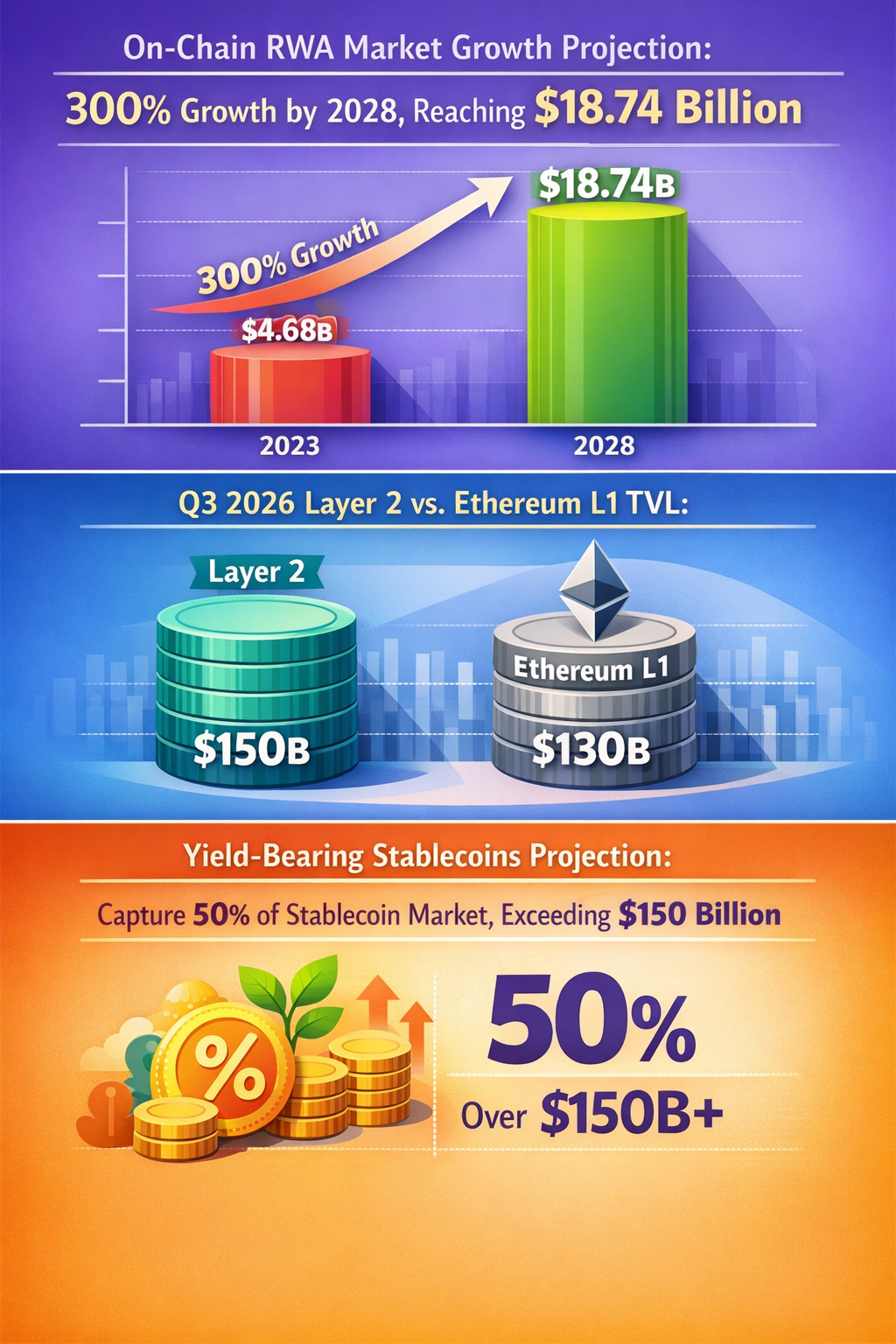
Recent forecasts predict Layer 2 total value locked (TVL) will surpass Ethereum Layer 1’s DeFi TVL by Q3 2026, with figures potentially reaching $150 billion versus $130 billion on mainnet (Blockeden 16/03/2026). This indicates critical mass adoption of modular blockchain architectures where security, execution, and data availability layers are decoupled, enhancing scalability and composability. This not only optimizes transaction throughput but further blurs distinctions between on-chain and off-chain capital flows.
Concurrently, attempts by central banks and institutional bodies to experiment with tokenized reserves and smart contract execution have progressed. The Bank for International Settlements’ (BIS) research into tokenized assets in central bank operations reveals how programmable money can streamline settlement and treasury workflows (Vocal Media 10/03/2026). Tokenization here transcends mere asset digitization and enables integrated monetary policy levers embedded directly into digital instruments. This marks a systemic evolution from traditional fiat instruments reliant on analog controls.
Another under-discussed development is the burgeoning thought leadership around yield-bearing stablecoins without bank-equivalent regulation, which would offer returns on Treasury-backed dollar balances resembling traditional savings products (Acceleron Bank 12/03/2026). Should regulators permit this, capital migration from legacy banking deposits into tokenized stablecoin protocols is plausible, eroding classical deposit franchises and elevating DeFi platforms as quasi-banking intermediaries.
The market is seeing a regulatory pivot, with jurisdictions moving toward formalized exchange-traded funds (ETFs) and licensed vehicles for crypto exposure that incorporate tokenized assets and futures trading rules in places like Thailand (Lexology 06/03/2026). This progressive embedding of tokenized capital into regulated frameworks signals an institutional mainstreaming of decentralized finance capabilities.
Separately, geopolitical experiments such as the Marshall Islands’ tokenized stablecoin distribution project (facing U.S. funding restrictions) highlight how digital currency governance and sovereign authority intersect. Such fragmented international approaches may accelerate federated decentralized financial ecosystems with variable regulatory and capital regime outcomes (Islands Business 16/03/2026).
Disruption Pathway
The modular blockchain-L2 scaling combined with tokenized reserves introduces a dual acceleration dynamic: technological optimization reduces transaction costs and latency at scale, while embedded programmable assets digitize and automate treasury and policy functions previously constrained by legacy infrastructure.
As Layer 2 TVL surpasses Layer 1, rebalancing incentives will shift capital allocation toward modular, flexible platforms that can interoperate with fiat and institutional treasury systems. This will stress incumbent monolithic blockchains and conventional banking deposit products, motivating centralized platforms and banks to embrace tokenized stablecoins and smart contract custody to retain market share.
Regulatory systems will face pressure to reconcile real-time programmable digital assets with compliance frameworks designed for static financial instruments. Guidelines focusing on licensing, transparency, and classification of tokenized reserves will evolve as these digital instruments begin serving systemic payment, savings, and reserve functions (Stablecoin Insider 14/03/2026).
Feedback effects may accelerate adoption: as consumers and institutions chase yield from regulated yield-bearing stablecoins, liquidity and capital inflows could bypass traditional banks, raising stability concerns and precipitating a redefinition of banking regulation and monetary policy transmission mechanisms.
Industry structures may decentralize, but paradoxically also see new concentrations of power in platforms controlling modular blockchain stacks and tokenized asset marketplaces. Governance models will struggle to balance interoperability and competition with security and regulatory control.
Why This Matters
For decision-makers allocating capital, this signal indicates a transformative shift in how digital liquidity is created, held, and deployed, potentially decoupling traditional banking and capital market intermediaries from their historical reserve and transaction roles. Early movers in modular chains and tokenized treasury-backed assets may capture outsized economic rents and reshape market composition.
Regulators must anticipate emergent systemic risks from the convergence of decentralized scalability with real-world asset tokenization. The absence of clear frameworks for yield-bearing stablecoins risks undermining deposit insurance analogues and macroprudential controls. Proactive engagement to shape emerging standards and licensing regimes could avert financial instability.
Industrial strategists should consider how modular infrastructures may fragment or concentrate innovation, influence protocol governance, and drive new financial service product categories. Supply chains for digital asset custody, oracle services, and compliance technology are likely to shift accordingly.
Implications
This signal may cause structural change by recalibrating foundational elements of monetary and capital market infrastructure rather than merely adding incremental efficiency. Tokenized stablecoins could likely become primary payment rails within 10–15 years (Tech Bullion 11/03/2026), and Layer 2 modular scaling may become the default DeFi execution environment.
Such a shift might challenge the primacy of sovereign fiat reserve currencies and crystallize tensions between decentralized financial innovation and centralized regulatory control (DWealth News 16/03/2026). However, this is not an inevitable cryptocurrency utopia; regulatory roadblocks like the U.S. Fed CBDC ban until 2030 demonstrate continuing constraints (DWealth News 16/03/2026).
Competing interpretations include viewing modular scaling as a purely technical upgrade with limited systemic upheaval or the tokenized treasury revolution as niche institutional experimentations unlikely to scale. However, the convergence of these trends makes such compartmentalized views less tenable.
Early Indicators to Monitor
- Validation of Layer 2 TVL surpassing Layer 1 TVL benchmarks by Q3 2026.
- Regulatory rulings or consultation papers permitting yield-bearing stablecoins without bank-equivalent regulations.
- Formal guidelines or pilot projects adopting tokenized central bank reserves or programmable treasury instruments.
- Growth in institutional adoption of tokenized asset ETFs and regulated crypto futures markets.
- Capital flow divergence from traditional bank deposits to tokenized stablecoin savings products.
Disconfirming Signals
- Prolonged stagnation or regression in Layer 2 adoption or TVL stagnation below Ethereum mainnet.
- Regulatory prohibition or strict limitation on yield-bearing stablecoins or tokenized treasury assets.
- A decisive resurgence of traditional CBDC initiatives overshadowing decentralized stablecoin adoption post-2030.
- Significant failure in modular blockchain interoperability causing fragmentation instead of composability.
- Major institutional retreat from tokenized asset strategies due to unresolved custodial or legal uncertainties.
Strategic Questions
- How should capital deployment strategies balance exposure between Layer 2 modular ecosystems and Layer 1 monolithic blockchains given the scaling inflection?
- What regulatory frameworks are required to safely integrate yield-bearing stablecoins and tokenized reserves into systemic payments and savings infrastructure?
Keywords
Tokenized Finance; Decentralized Finance; Layer 2 Scaling; Stablecoins; Smart Contracts; Modular Blockchains; Regulatory Frameworks; Central Bank Digital Currency
Bibliography
- By Q3 2026, analysts are predicting with 75% confidence that Layer 2 TVL will exceed Ethereum L1 DeFi TVL: $150 billion versus $130 billion on mainnet. Blockeden. Published 16/03/2026.
- The WEF report explains that smart contract execution can streamline servicing and settlement workflows in financial markets, and BIS research has gone even further by testing how tokenized reserves and assets could support central-bank operations with smart contracts. Vocal Media. Published 10/03/2026.
- If yield-bearing stablecoins are ultimately permitted without bank-equivalent regulation, platforms could offer returns on Treasury-backed dollar balances that look and feel like savings products to everyday consumers. Acceleron Bank. Published 12/03/2026.
- Forthcoming measures will include formal guidelines for crypto exchange-traded funds, permitting licensed asset managers to offer regulated exposure to digital assets through on-exchange vehicles, as well as rules to allow crypto futures trading on the Thailand Futures Exchange. Lexology. Published 06/03/2026.
- 2026 looks less like a year of proving that stablecoins work and more like a year of deciding how they will fit into global payments, treasury systems, and digital money competition at scale. Stablecoin Insider. Published 14/03/2026.