
Decoding the Unseen Trajectory: Low Earth Orbit Satellite Traffic as a Structural Inflection in Global Connectivity
As Low Earth Orbit (LEO) constellations proliferate, a deeper, lesser-known signal emerges around orbital management complexity and competitive leverage rooted in dynamic satellite repositioning. This insight reveals a latent inflection point poised to reshape capital flows, regulatory frameworks, and competitive dynamics within the global connectivity ecosystem over the next two decades.
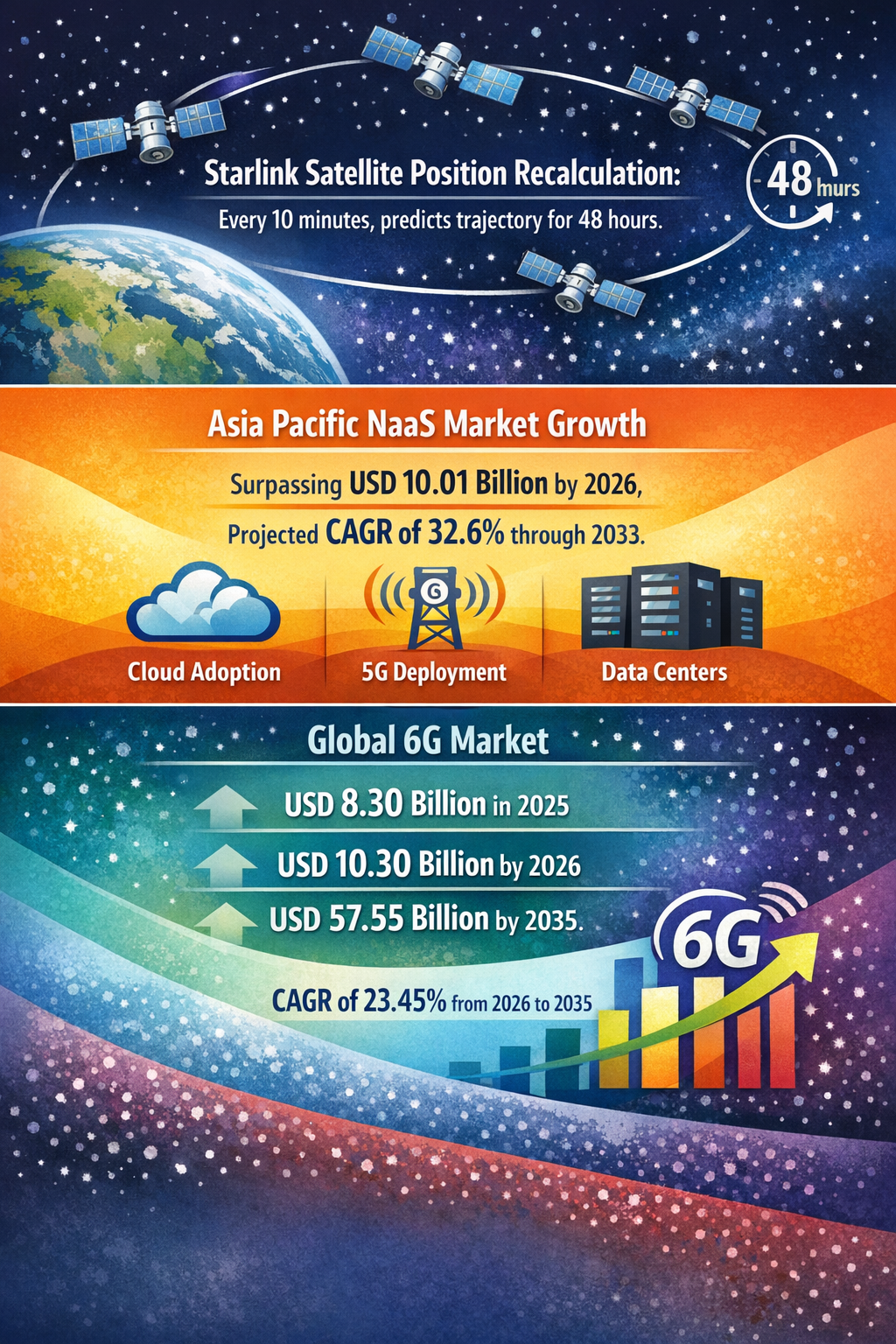
While larger narratives focus on 5G expansion and broadband democratization via constellations such as Starlink and Project Kuiper, an advanced architectural shift underlies these trends: the continuous onboard trajectory prediction and spatial recalibration of thousands of rapidly orbiting satellites. This capability, performed every ten minutes by each Starlink unit (Scientific American 16/03/2023), signals a transition from static space assets to cyber-physical systems that autonomously optimize their spatial economy. This emergent capability constitutes a weak signal with the potential to catalyse a structural adaptation in how orbital assets are valued, regulated, and competitively leveraged, extending far beyond current discourse.
Signal Identification
This development qualifies as a weak signal transitioning toward an emerging inflection, situated within a medium to high plausibility band over a 10–20 year horizon. Unlike headline-grabbing mass satellite deployments, the autonomous, predictive recalibration of trajectories is not widely discussed but is crucial, as it endows operators with real-time agility in managing orbital traffic and interference risks. Sectors exposed include aerospace, telecommunications, internet service providers, defense and security, regulatory bodies, and capital investors in space infrastructure.
What Is Changing
Starlink’s dynamic satellite management system recalculates position and predicted trajectory every ten minutes for up to 48 hours (Scientific American 16/03/2023). This contrasts markedly with traditional geostationary satellites positioned about 36,000 kilometers above Earth and largely static (Law & Economics Center 05/06/2023). By operating 300 to 2,000 kilometers above Earth in LEO, constellations are now operating in a complex, dynamic traffic environment requiring continuous course correction to minimize collision risk and signal interference (Law & Economics Center 05/06/2023).
Simultaneously, these continuous autonomous adjustments improve service quality by enabling operators to optimize coverage density and bandwidth allocation in near real-time. This system-level sophistication facilitates massive constellation launches, where a single Starship mission can deploy hundreds of satellites simultaneously (Channel News Asia 23/03/2023). The ability to reposition satellites en masse and responsively recalculate their trajectories in tight orbits is not only a technical necessity but also a competitive moat.
Meanwhile, connectivity expansion, indicated by projections such as half of Latin America’s mobile connections migrating to 5G by 2030 (Alcor 12/01/2023), will intensify demand for stable, low-latency links served by these LEO constellations. The coupling of terrestrial 5G networks with spaceborne assets strengthens multi-layered connectivity architectures, but requires regulatory harmonization around increasingly complex orbital management dynamics.
Disruption Pathway
The maturation of continuous orbital recalculation represents a shift from static space assets to cyber-physical ecosystem components. This transition may accelerate as constellation operators seek operational agility to maximize spectral and spatial utility amid saturated orbital lanes. The launch frequency of mass LEO satellites, motivated by decreasing launch costs and revenue upside from constellations, intensifies the imperative for automated traffic management (Channel News Asia 23/03/2023).
As orbits become congested, traditional regulatory frameworks based on fixed position licenses and spectrum allocation will experience stress. The decentralization and automation of trajectory control introduce challenges in compliance monitoring, collision liability, and interference adjudication, catalyzing a need for novel regulatory paradigms enabling dynamic coordination among competing operators (Law & Economics Center 05/06/2023).
Structural adaptations may include the rise of orbital traffic management markets, standardized dynamic “right of way” protocols, and cross-operator data-sharing platforms underpinning safe and efficient spatial multiplexing. Feedback loops will arise as operators invest in more adaptive satellites to capture market share, potentially marginalizing older, less flexible incumbents. Regulatory bodies and international consortia may be forced to broaden their mandates, integrating cybersecurity, data governance, and real-time collision avoidance into their oversight functions.
This could precipitate a paradigmatic shift in the commercial space ecosystem, where capital allocation preferences tilt heavily toward operators with advanced on-orbit autonomy capabilities and proven dynamic traffic coordination protocols. The dominant providers of launch services (e.g., SpaceX with Starship) simultaneously shape this ecosystem through cost advantages and deployment scale (Channel News Asia 23/03/2023).
Why This Matters
For senior decision-makers, recognising this nuanced inflection around dynamic LEO satellite management informs capital prioritization toward enterprises innovating in cyber-physical space operations, satellite autonomy, and orbital coordination. Regulatory frameworks lagging behind this emerging reality risk becoming obsolete or incapable of ensuring space traffic safety, potentially incurring economic loss from collision damage or service disruption.
Industrial strategies must anticipate shifts favoring vertically integrated models combining launch capacity, satellite manufacturing, and fleet management software. Emerging standards in orbital traffic coordination will influence supply chain dependencies and cross-border liabilities, necessitating international governance cooperation and new risk governance models.
Implications
This signal could plausibly scale into structural change that fundamentally alters global space governance and industry competitive architectures. Regulatory regimes may evolve from siloed static licensing toward dynamic, adaptive frameworks incorporating autonomous trajectory management and real-time coordination mandates. Capital allocation could increasingly favor operators capable of integrating these autonomous capabilities and deploying satellites in dense, flexible constellations, ultimately transforming how connectivity networks are architected worldwide.
Importantly, this development is not merely an incremental upgrade to satellite operations but a foundational shift that redefines the operational paradigm for space infrastructure. It is not simply about increasing 5G coverage or lowering latency but about creating a continuously self-optimizing orbital ecosystem. Competing interpretations might dismiss this as technical detail or manageable operational complexity, yet the strategic implications in terms of regulatory overhaul and redefined competitive advantage are likely profound.
Early Indicators to Monitor
- Increased patent filings around autonomous orbital navigation and collision avoidance algorithms.
- Procurement shifts favoring satellites with onboard dynamic trajectory prediction capacities.
- Regulatory drafts or proposals introducing dynamic orbital coordination requirements or traffic management policies.
- Venture capital clustering in startups developing orbital autonomy and space traffic coordination platforms.
- Capital reallocation trends toward vertically integrated satellite operators with launch capability and autonomous fleet management.
Disconfirming Signals
- Significant regulatory barriers instituting rigid fixed-spectrum or orbital slot allocations refusing dynamic adaptation.
- Catastrophic satellite collisions leading to industry-wide risk aversion and slowdown in LEO constellation expansion.
- Technological failures undermining the reliability or cost-effectiveness of autonomous trajectory recalculation.
- Emergence of alternative connectivity paradigms (e.g., terrestrial-only 6G or quantum networks) that reduce reliance on satellite LEO infrastructure.
- Geopolitical fragmentation blocking international frameworks for orbital traffic data sharing and coordination.
Strategic Questions
- How should capital be reallocated to favor systems capable of real-time dynamic orbital management versus volume-based deployment strategies?
- What regulatory models can effectively govern autonomous LEO traffic without stifling innovation or inducing systemic risk?
Keywords
Low Earth Orbit; Autonomous Satellites; Orbital Traffic Management; Space Regulation; Connectivity Infrastructure; Satellite Constellations; Capital Allocation; 5G Expansion
Bibliography
- Every 10 minutes each Starlink satellite recalculates its position and predicts its trajectory for the next 48 hours. Scientific American. Published 16/03/2023.
- Half of all mobile connections in Latin America will run on 5G by 2030. Alcor. Published 12/01/2023.
- Systems such as Starlink and Project Kuiper operate roughly 300 to 2,000 kilometers above Earth, far below geostationary satellites at about 36,000 kilometers. Law & Economics Center. Published 05/06/2023.
- A single Starlink mission using Starship could bring in tens of millions of dollars more in revenue for SpaceX than launching a commercial customer's payload to space. Channel News Asia. Published 23/03/2023.